 |
By Dave Dunwoody,
Technical & After Sales Specialist at Kawasaki Engines |
In this guide, we explain why fuel filters are so important to protect the engine, how to tell if they need to be replaced, and why choosing a genuine Kawasaki filter matters.
Whether you’re maintaining large open lawns, mowing small back gardens, towing garden equipment, or leaf clearing, your lawn mower engine relies on one small component to keep its fuel system clean and protected: the fuel filter.
It’s inexpensive, easy to overlook, but one of the most important parts in your Kawasaki engine. Here's why.
What does a fuel filter actually do?
Think of your fuel filter as your engine’s first line of defence. Its job is simple: to keep dirt, dust, rust, water, and other contaminants from reaching the engine.
Without it, those particles are free to travel through the fuel system, where they can damage precision components such as the carburettor or fuel injectors. And since modern fuel systems operate to extremely fine tolerances, even microscopic particles can cause expensive problems down the line.
What happens if contaminated fuel gets past the filter?
In this scenario, debris can clog, score, or permanently damage sensitive fuel system components, while water contamination can also lead to corrosion.
In severe cases, this can result in costly repairs or even the need to replace the whole engine.
Can a fuel filter issue affect performance?
Absolutely. A fuel filter that is partially blocked doesn’t just reduce fuel flow, it affects how your engine performs every time you run it.
Fuel economy
A restricted fuel flow means that the engine receives less fuel than it needs. This disrupts the delicate air-fuel mixture balance, leading to a less efficient combustion and to the need to open the throttle more often to maintain performance. The result? Higher fuel consumption.
Power
One of the first things operators notice when a fuel filter isn’t working properly is a loss of power. You may experience:
- Sluggish acceleration
- Hesitation when increasing revs
- Poor response under heavy loads
- Reduced performance on slopes or uneven ground
Engine life
A clogged filter also places additional strain on the fuel pump, which has to work harder to deliver enough fuel. Even more importantly, if contaminants reach the carburettor or the fuel injectors, they can cause permanent wear, scratching and blockages that significantly reduce the overall life of the engine.
Why is a consistent flow of clean fuel so important?
Your Kawasaki engine is engineered to run on a precise air-fuel mixture. Clean fuel delivered at a consistent rate allows complete combustion, smooth operation and maximum efficiency.
Any interruption – whether caused by contamination or a restricted filter – can upset that balance, reducing overall performance and increasing engine wear.
Signs your fuel filter might be failing
Fuel filter problems often become most noticeable when the engine is working under load.
Common warning signs include hesitation when accelerating, sluggish engine response, rough idling, and difficulty starting. In some cases, the engine may surge or briefly lose power during operation.
Because these symptoms can also be associated with other fuel system issues, it’s important to inspect the filter regularly, and definitely whenever performance begins to decline.
Can you inspect a fuel filter visually?
Yes. Genuine Kawasaki fuel filters feature a transparent housing, which makes inspection quick and easy.
A simple visual check allows you to see whether the filter is excessively dirty or discoloured, helping you decide whether it needs to be replaced.
When should a fuel filter be replaced?
Every Kawasaki engine has its own recommended inspection and replacement intervals outlined in the owner’s manual, which are based on normal operating conditions.
However, if your equipment regularly works in dusty environments, long grass, or other harsh landscaping conditions, filters may need to be replaced more frequently.
This is because challenging operating conditions expose the fuel system to more contaminants, meaning filters may become saturated well before the standard service interval. Ultimately, inspecting your filters regularly, before telltale symptoms appear, is the best way to stay ahead.
Bonus tip: replace, don’t clean
Although it may seem like an easy fix, never attempt to clean or wash a fuel filter. These parts are designed to be replaced, not cleaned, and attempting to reuse a contaminated filter can compromise its effectiveness.
Also, make sure the new filter is installed correctly. It may come as a surprise, but one of the most common installation mistakes is fitting the filter in the wrong direction.
Fuel filters are designed with a specific direction of fuel flow, usually indicated by an arrow on the filter housing. Installing the filter backwards can restrict fuel flow, reduce engine performance and, in some cases, force trapped contaminants back through the fuel system. Always check the flow arrow before fitting a replacement filter.
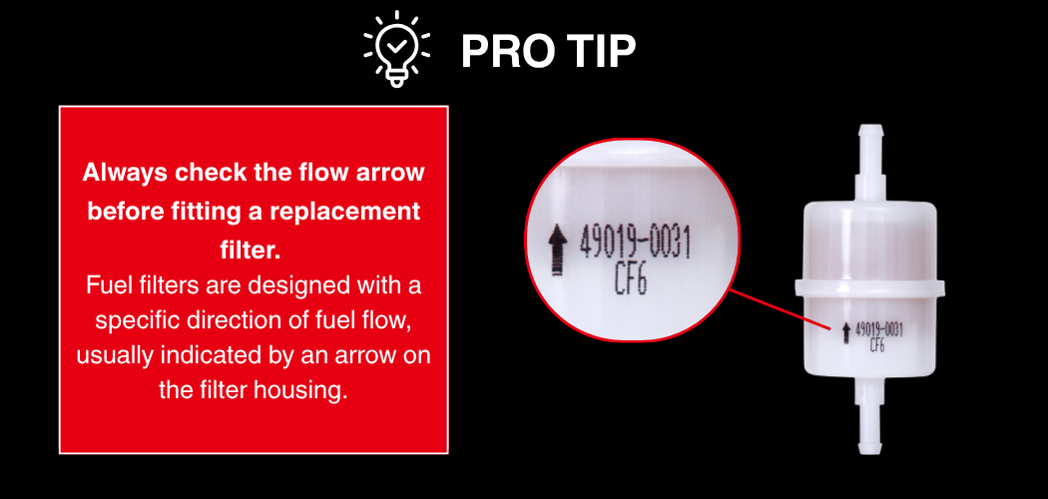
(PRO TIP Always check the flow arrow before fitting a replacement filter. Fuel filters are designed with a specific direction of fuel flow, usually indicated by an arrow on the filter housing)
Genuine vs aftermarket fuel filters: what's the difference?
At first glance, many aftermarket fuel filters appear almost identical to genuine parts.
However, the biggest differences are found inside the filter, where the quality of the filtration media and the level of protection they provide can vary significantly.
Why is a genuine fuel filter superior?
One of the key advantages of a genuine Kawasaki fuel filter is its 10-micron filtration rating. This means it is designed to capture even microscopic particles while maintaining the consistent fuel flow required for optimal engine performance.
The filter media also provides a large filtration surface area, helping it retain contaminants efficiently without unnecessarily restricting fuel delivery. Together, these features help maintain clean fuel, efficient combustion, and reliable engine performance throughout the filter’s service life.
Last but not least, genuine Kawasaki fuel filters are designed for use across Kawasaki’s petrol engine range, including Electronic Fuel Injection (EFI) engines, where fuel system components operate to extremely fine tolerances.
The hidden risks of cheaper alternatives
Lower-cost aftermarket filters can appear to offer similar performance, as differences in their internal construction are not always visible.
Filters with a higher micron rating, for example 20 or 30 microns, allow larger contaminant particles to pass through the fuel system. While these particles may be very small, they can still cause significant damage over time.
Another risk is that some aftermarket suppliers recommend standard carburettor fuel filters for EFI applications. Although they may appear compatible, these filters are not designed to provide the level of filtration required by EFI systems, increasing the risk of injector damage and reduced engine reliability.
While a non-genuine filter may cost less upfront, any savings can quickly be outweighed by reduced engine performance, increased maintenance costs and the potential for expensive repairs. Choosing a genuine Kawasaki fuel filter instead helps ensure the level of filtration and protection the engine was designed to receive.
To learn more about the difference between genuine and aftermarket parts – and the effects they can have on your engine – read our full comprehensive guide, which directly compares the two.
Where can you buy genuine Kawasaki Engines fuel filters?
Use our dealer locator to find your nearest Authorised Kawasaki Engines Dealer and keep your equipment performing at its best with genuine Kawasaki parts.
Our extensive dealer network across Europe can help you find the right parts for your specific engine model, along with expert advice on servicing and maintenance.
And don’t forget to check out our latest blogs and guides for more practical engine maintenance tips, including our practical genuine parts guides to the air filter, oil filter, and spark plugs.