11 Apr 2023
4-stroke engine maintenance: a how-to guide
Maximising your engine's performance and longevity requires regular maintenance: it can add years on to the life of an engine.


This article looks at the difference between 2-stroke and 4-stroke engines, and which engine type is better suited to certain applications within landscape maintenance.
Have you ever wondered what the difference is between 2-stroke and 4-stroke engines? When you're first starting out in professional landscaping, you may begin to hear the two terms mentioned in relation to garden machinery.
As engine experts, and manufacturers of both, we explain everything you need to know, from how they work and the benefits of each type, to their most suitable applications in landscape maintenance.
The answer might seem complex, but at its heart, it's simple: they earn their name from the number of piston strokes (the number of times the piston travels up or down inside the cylinder) it takes to complete a combustion cycle.
A two-stroke engine requires only two strokes of the piston to complete a cycle, while a four-stroke takes four piston strokes to complete the cycle. This translates to either one crankshaft revolution – in the case of two-stroke – or two crankshaft revolutions – in the case of four-stroke – per ignition event.
Both being internal combustion engines, there are similarities; both have pistons, cylinders, crankcases, and crankshafts, and perform crankshaft revolutions to generate power.
They do quickly start to differ, however, when you look at how they operate – we’ll go into more detail on that later.
Other key differences between two-stroke and four-stroke engines include:
The four stages of combustion are clearly separated in four-stroke engines.
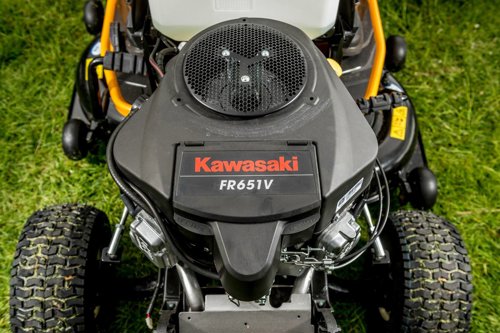
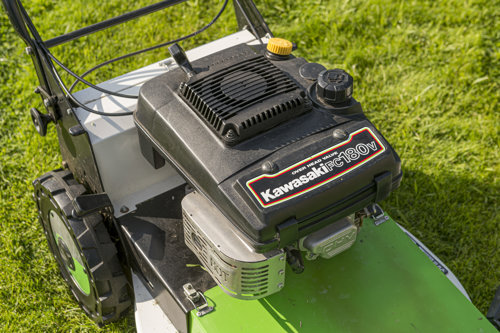
Kawasaki four-stroke engines are built for professional use, with superior filtration and durable parts engineered to maximise performance.
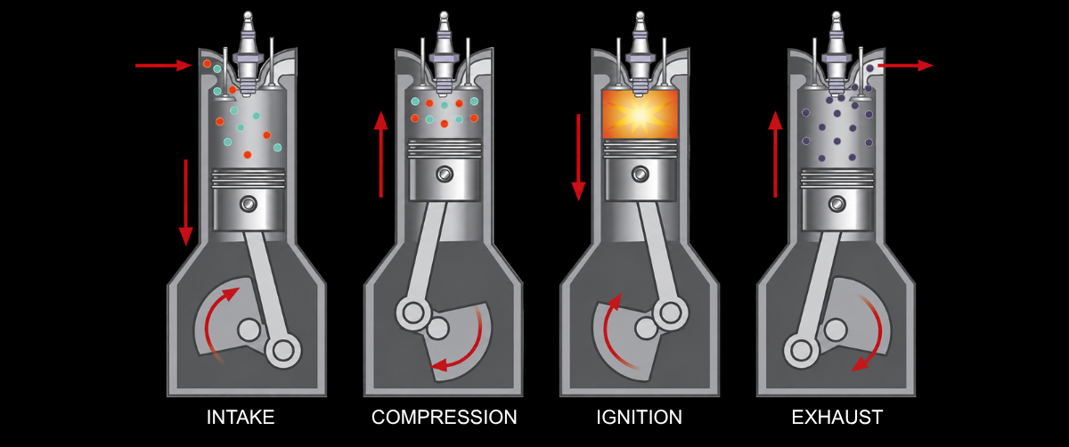
In a two stroke engine the action that creates a combustion event takes place both below the piston in the crankcase and above the piston in the combustion chamber.
Initially focusing below the piston, the correct ratio of air and pre-mixed fuel/oil from the carburettor is drawn through a one way valve into the crankcase, the volume under the piston increasing as the piston ascends – this is the intake stage. When the piston descends, the volume of the crankcase under the piston reduces, forcing the air/fuel/oil mixture through the transfer ports in the cylinder to the area above the piston.
Above the piston, the air/fuel/oil mixture from the transfer ports is now compressed by the piston as it ascends the cylinder – the compression stage. At an RPM dependent point before the piston reaches the top of the stroke, the spark plug is fired – this is ignition. The descending piston uncovers the exhaust ports and the burnt mixture exits the combustion chamber, for exhaust.
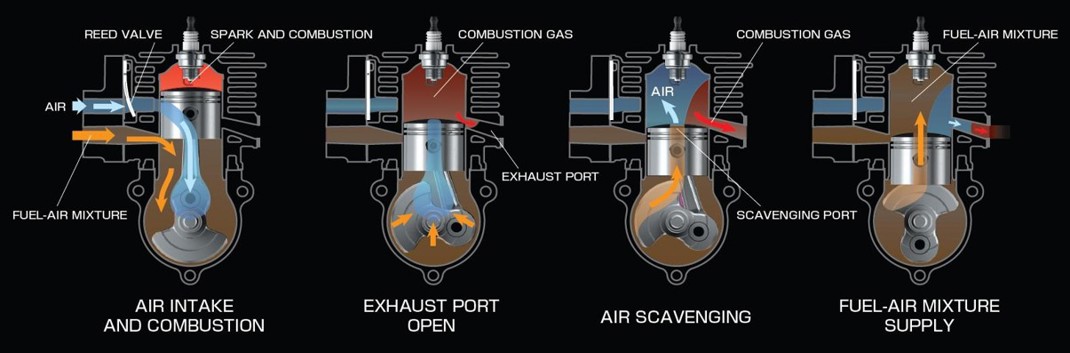
In a Kawasaki two-stroke engine, we minimise the amount of oil necessary, with a 50:1 fuel mixture, and help you save on fuel thanks to our stratified scavenging system, powering your engine with a cleaner fuel air mixture to improve efficiency.
Though they have different strengths, it's not really a question of which engine is better. It's about which is better suited to certain applications.
With their excellent power-to-weight ratio, two-stroke engines are a natural choice for handheld equipment such as brushcutters and multi-tools.
When you're working long hours, the weight you carry can have a significant impact on your physical health. The more you can reduce it, the better for your wellbeing – two-stroke engines offer the power required to cut through tough brush, without adding unnecessary strain.
Thanks to their higher torque, four-stroke engines are better suited to mowers.
Powering through thick grass or inclines requires more torque. If you're putting your mower through its paces – as most professionals do – the torque and consistency of a four-stroke engine is essential.
Kawasaki four-stroke engines power a range of lawn equipment, from ride-on mowers to remote-controlled slope mowers. Their reliable, consistent performance and efficient power are designed for professional landscapers – and each engine series is engineered for a different level of demand.
|
Feature |
2-stroke engine |
4-stroke engine |
|
Combustion cycle |
Completed in two strokes (one crankshaft revolution) |
Completed in four strokes (two crankshaft revolutions) |
|
Power output |
Higher frequency; fires every crankshaft revolution |
Lower frequency; fires every other crankshaft revolution |
|
Lubrication |
Oil must be pre-mixed with fuel |
Dedicated oil lubrication system |
|
Weight |
Lightweight (fewer moving parts) |
Heavier (includes valves, camshaft, flywheel, etc.) |
|
Torque |
Less torque |
High torque |
|
Maintenance |
Minimal and simple |
More involved |
|
Most suited to |
Handheld tools (brushcutters, multi-tools, hedge trimmers) Choose a two-stroke if you need to carry the tool all day. It’s light, powerful, and straightforward to maintain. |
Mowers (walk-behinds, ride-ons, and slope mowers) Choose a four-stroke for heavy-duty work. The high torque ensures your engine will cope with tough conditions and demanding workloads. |
Whether you're using a two-stroke or four-stroke engine as a professional landscaper, you need to know you can rely on it for consistent power and exceptional engine performance.
Kawasaki engines have earned the trust of landscapers over decades. Reliable, long-lasting, and high-quality: we're the professionals’ choice.
Find out more about why you should choose a Kawasaki engine for your landscaping machinery, or explore the equipment Powered by Kawasaki engines today.
Whether it's better to get a two-stroke or four-stroke engine is dependent on the application; a four-stroke is generally heavier, which can add extra strain when using handheld equipment – and why our two-stroke engines exclusively power handheld equipment – but its high torque is essential if you're using a ride-on mower.
A four-stroke engine is able to cope exceptionally well with tough, demanding workloads thanks to its high torque. Two-stroke engines, on the other hand, have a better power-to-weight ratio, and require less maintenance.
While some mowers may feature two-stroke engines, the vast majority of professional mowers use four-stroke engines due to their superior fuel efficiency, torque, and durability. Powered by Kawasaki mowers feature four-stroke engines exclusively.
Powered by Kawasaki brushcutters are powered exclusively by two-stroke engines. The high power output and low weight of a two-stroke engine mean they are generally the better choice for handheld equipment. Four-stroke brushcutters are typically more complex due to the extra internal parts and also require regular oil changes, whereas a two-stroke lubricates itself automatically through the fuel mix.
Maximising your engine's performance and longevity requires regular maintenance: it can add years on to the life of an engine.

Kawasaki Engines’ consistent quality isn’t the product of chance. It’s the result of adhering to strict processes and extremely careful attention to detail.
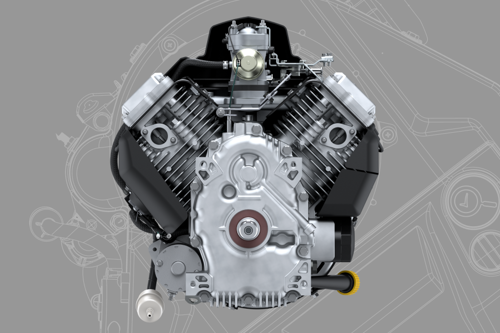
Have you ever wondered what makes an engine Kawasaki quality? Or what the difference is between a reliable engine, and one that lets you down?
In the demanding world of professional landscaping, the reliability and longevity of your equipment are paramount. Extra repair costs, unnecessary downtime and, ultimately, a hit to your bottom line can all result from purchasing machinery that's not fit for professional-level work.