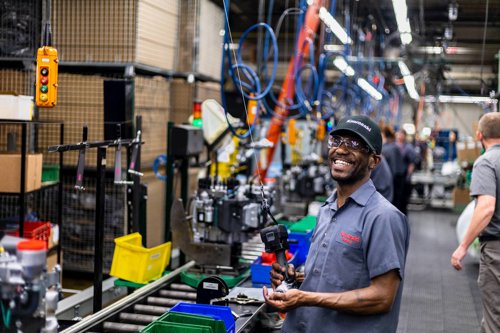
We spoke to Scott James, Director of Operations at Kawasaki Motors Manufacturing Corp. U.S.A, to find out more about how Kawasaki Engines manufacturing has evolved at our Maryville plant, and his experiences over nearly 40 years in the business.
Almost 40 years have passed since our V-twin 4-stroke manufacturing plant in Maryville produced its first engine – and Scott James, who today heads up the facility, has been part of operations since the very beginning.
From childhood dream to reality: Scott has progressed from the factory floor to Director of Operations over the course of his career. It’s given him a unique perspective on the changes at the plant – and manufacturing in general – since 1989.
Find out Scott’s ‘three Rs’, which he credits as the secret to his success, the ways technology has changed – and remained the same – since the factory opened, and how Maryville has continuously improved and delivered engines professional landscapers can rely on for years.
A 37-year-long career with Kawasaki
Four decades is an entire career for some people – and Scott has dedicated his to Kawasaki. In 1989, Scott worked in production assembly – the first of many roles within the business, which included overseeing the addition of a third shift to the machining section, starting the strategic planning department in Maryville, and managing production assembly as Deputy Director.
Scott has worked his way up from an entry-level job to being responsible for the entire plant as Director of Operations. Scott comments, “I always tell people that I grew up in Kawasaki. It sounds a little corny, but when I was a young boy, I dreamt about working in Kawasaki. It’s been fantastic to have the opportunity to play a role in a company that has such a strong positive impact on our communities.”
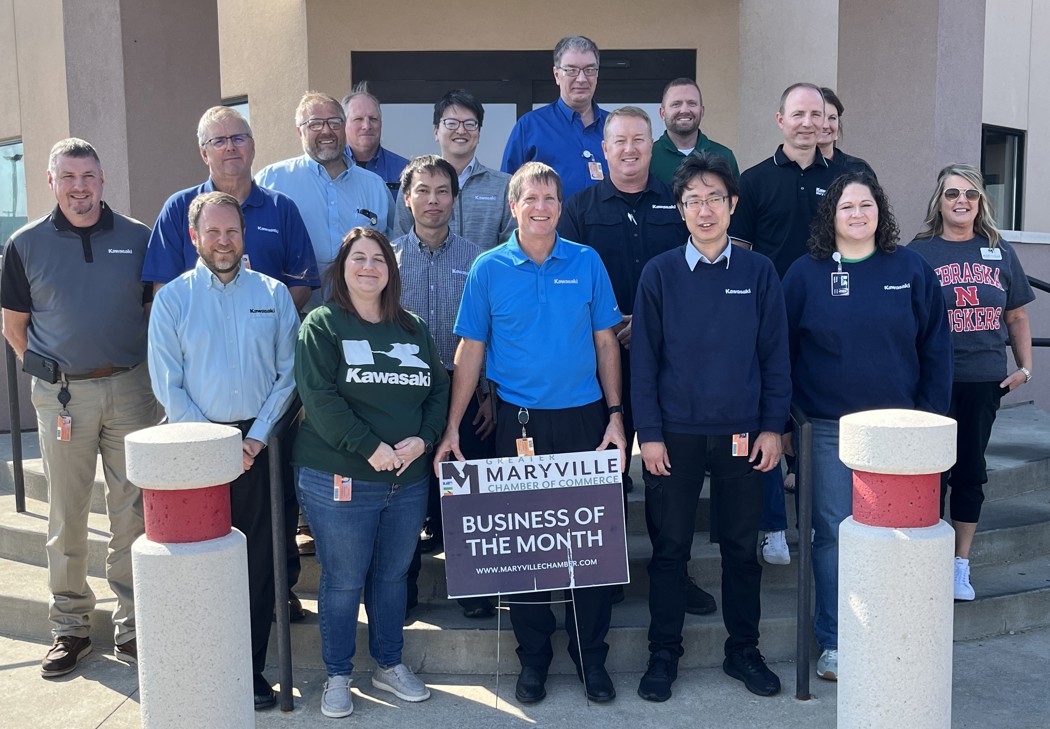
Kawasaki in 1989 to modern-day manufacturing – Maryville’s first engine
Kawasaki was the first foreign vehicle manufacturer to open a manufacturing plant in the US; the Lincoln facility was established in 1974. This laid the groundwork for Maryville to follow in its footsteps, and in June 1989, the plant opened to produce a single engine model, for a single customer – the FC150V engine.
Scott adds, “We had one assembly line in a 245,000 square foot building. It was just one engine for one customer – we started out with the FC150V walk-behind lawnmower engine. From there, we started to make FB series engines for garden tractors – zero-turn mowers hadn’t caught on yet! Everybody either had a walk-behind or tractor style mower back then.”
“For some time, we also produced ATV (All Terrain Vehicle) engines, but we eventually switched with Japan, instead bringing more of their lawn and garden production to Maryville, as it’s the core of our business.”
The Maryville plant has transitioned from producing a single walk-behind mower engine to a range of high quality, professional grade engines for a wide variety of mower types from zero turns to specialist commercial slope mowers. Now, Maryville produces Kawasaki’s current lineup of V-twin engines, including the FR, FS, FX, and FT series.
Plenty has changed since 1989, but some things have remained, as Scott says, “Our original assembly line is still in production today. And the funny thing is, it's not called line number one – it's line number nine.”
“At this point, I say our whole facility was all built around that first line, because we have literally built so much around it. We've of course made improvements and modifications to the line as technology has advanced, but it’s still in production.”
To meet customer demand and ensure equipment is available when professionals need it, Maryville has grown significantly. “We set out with the target of making 900 units a day in 1989. When we started, you know, it was just one engine, one customer. Today, we have ten assembly lines in operation in Maryville, and five at Boonville." The growth of Maryville is clear in assembly, but some of the most significant and impactful changes happened in other parts of the facility.
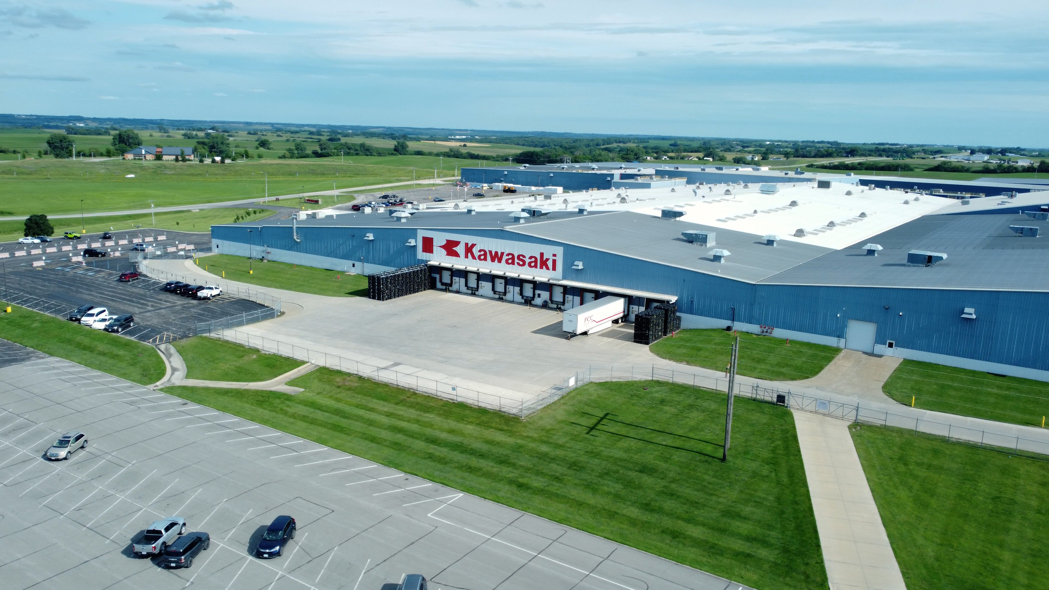
Bringing end-to-end production to Maryville: die casting, machining, and assembly
Our Maryville plant is home to more than just assembly. Crankcases are cast from raw aluminium ingots in die-casting, parts are shaped to precise specifications in machining, and then assembled and test run to deliver the final engine. All under the watchful eye of a dedicated quality team.
From molten aluminium to the finished engine, the entire production of our V-twin engines is in Maryville. Why does this matter? Because it means we can control the process – and quality – from the very beginning.
Quality is always a priority at Kawasaki, and the move to add first machining, and then die-casting, only enhanced our ability to guarantee reliability. As Scott comments, “Each time we added some of that vertical integration, it really made us more valuable, because we could do it better in-house, and we didn’t have to deal with the logistics of sourcing parts elsewhere.”
“At first, parts were cast in Japan and shipped to us for production. We started to discuss, can Maryville do this? And so it was decided to invest the capital to actually start casting those parts to feed our machining, instead of being shipped across the world.”
Besides die-casting, machining, and assembly, Maryville was also once home to research and development. Though Kawasaki Engines R&D has since moved to Grand Rapids, Michigan, it started in Maryville in 1995 – the first engine fully developed at Maryville was the FH500V.
The culture: quality built-in
From senior leadership to the factory floor, the dedication to providing a high-quality product is clear as soon as you set foot in the facility.
Maintaining exceptionally high standards is written into the DNA of Maryville, and the mindset is one of continual improvement. So much so that, as Scott suggests, “quality is built into our product every step of the way.”
“Continual improvement is such a big part of it, because that maintains our focus. It’s part of everything we do, driving quality, our processes, our training, and our communication. We make the standards clear for everybody.”
Everyone involved in the manufacturing plant shares a clear sense of pride. Making sure that people can rely on equipment powered by a Kawasaki engine is more than a distant ambition – it’s personal.
Scott adds, “We make products that our families, our friends, our neighbours use in their everyday lives. So, you know, not only do we build a product for our customers, we interact with our customers on a regular basis.”
“You can't really work here and not interact with the people that use your product. It helps to build that culture, the commitment of putting out a quality product, because none of us want to go home and hear our family or friends say how their engines are not performing well. No one wants to hear, ‘Boy, you guys didn't make a very good engine!’ We all feel that sense of pride.”
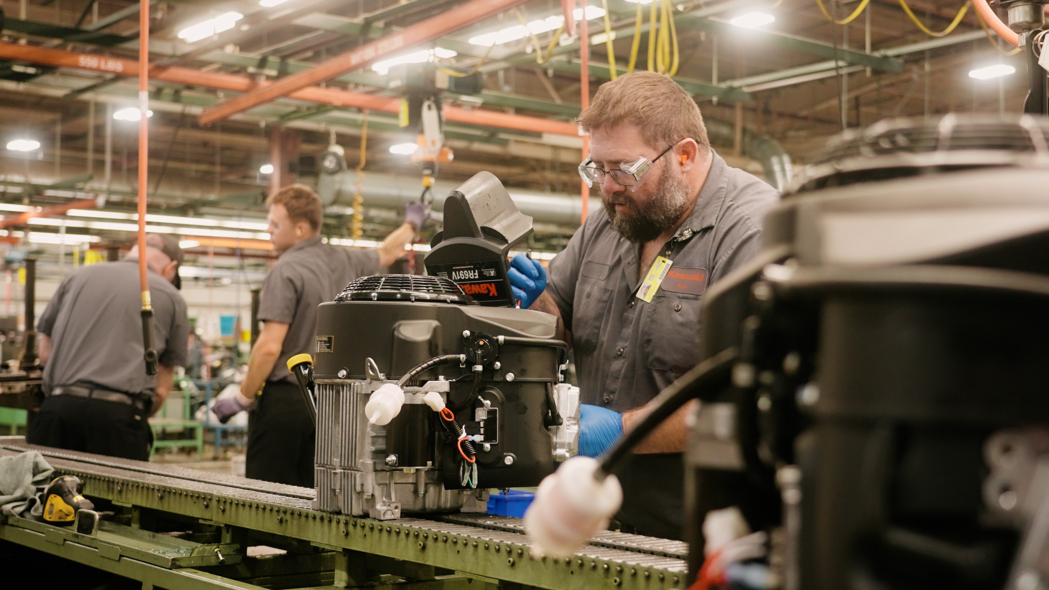
How has Kawasaki manufacturing technology evolved in almost 40 years?
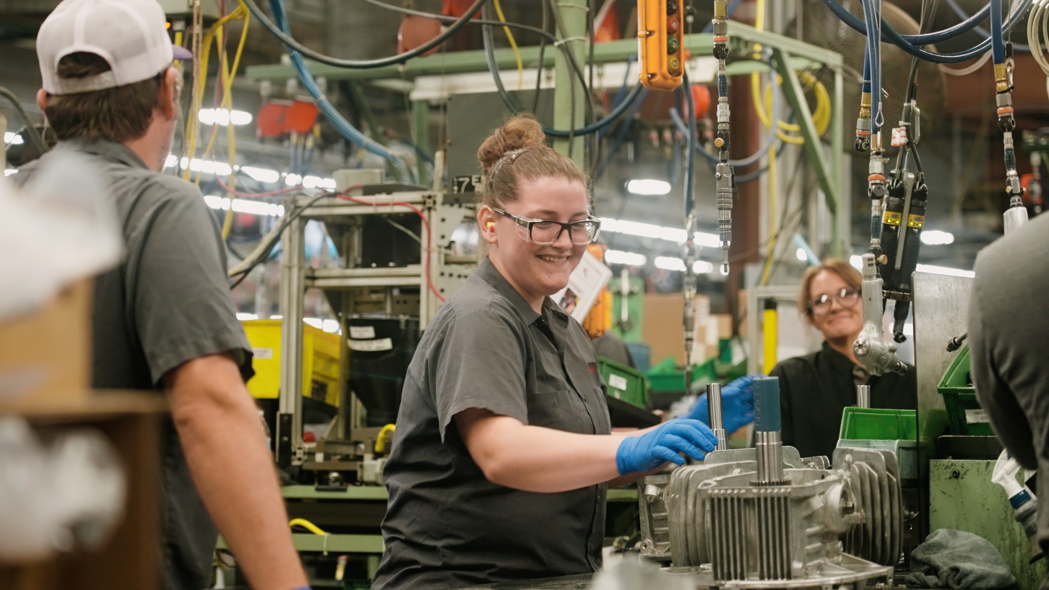
Manufacturing technology has come a long way since 1989. In Maryville, processes have shifted from completely manual operations to a mixture of manual and automated, improving efficiency, employee safety, and quality control.
“In the first assembly line, we were dependent on the accountability of each individual person. Now, we have machines and equipment and controls in place – if something is missed, we’re alerted to it.”
“In machining, a part had to go through 29 different machines, each set up for a specific single process. It required a lot of time and handling from operators. It was the same in die-casting – there were more manual operations. Today, we have robotics in place, and can do multiple processes with a single machine. It’s much safer for our staff.”
Approaches to recycling have also changed significantly since 1989. Kawasaki Engines makes a concerted effort to minimise waste wherever possible, and this attitude is clear in the Maryville facility. Scott explains, “We started off just looking to reduce what we're sending to landfill. Now, we’re reusing or recycling excess cast iron, steel, aluminium, etc., reducing packaging, and using returnable containers. We’re also constantly looking at the chemicals and coolants used for our machining processes.”
As manufacturing technology and practices have evolved, so has our engine technology. From meeting emissions limits to improving fuel efficiency, regulatory shifts and landscaper challenges are being addressed. Scott notes, “We've seen changes from carburetted, to starting to shift to EFI. One of the biggest things we've recently released is our EVO series engine.”
“We’ve also made some new improvements to make it easier to change or refill the oil. We just continue to look for how we can make it better for everybody.”
Generations of craftsmanship
Generations of people have worked and continue to work at the Maryville plant, which employs over 900 people. There’s a strong sense of community, and long-serving employees are common – 16 people employed when the factory opened in 1989 still work at the facility today.
It helps reinforce the culture of care and commitment present in the factory. For many, it’s an honour to work for Kawasaki; an opinion shared across families. Scott comments, “Families share the pride in what they do. Naturally, their family members want to come to work here. For me personally, when I started at Kawasaki in 1989, my aunt was working here at the time. My cousin started a week after I did and he's still here today. My wife retired from Kawasaki after 23 years of service.”
The family atmosphere at Maryville is obvious to any onlooker, as is the strong Midwestern work ethic. Scott brings this to Kawasaki, growing up on a farm – even today, when not at Kawasaki, Scott is likely to be found on a tractor managing his own small farm.
The foundation of Scott’s approach and success at Kawasaki came from those early days, based on advice from his parents, “They taught me the three ‘Rs’, respect, responsibility, and resourcefulness.” Scott says, “Respect, meaning valuing people and their contributions. Responsibility, meaning doing what you say you're going to do and taking ownership when something needs attention. Resourcefulness, meaning to find a way forward even if you have challenges. These values have really been the foundation of my work ethic, and helped me at Kawasaki.”
The future of Kawasaki Engines manufacturing
Our Maryville facility is almost unrecognisable from its opening almost 40 years ago. From rapid expansion to technological advancements, the plant has evolved to meet the demands of our industry, maintaining the high quality standards Kawasaki is famous for.
Commenting on what the Maryville plant could look like in another ten or 20 years, Scott speculates, “Technology is moving so quickly. It's really difficult to predict exactly. I expect it'll be more automation, we'll be using more data to evaluate how we can improve, and have technology that'll help us work even safer than we do today.”
“Our product lineup will of course evolve as we move forward. That's part of what has made us a leader in our industry – that we're always looking at what we can do to make our engines better for our customer, for our OEMs or the end user.”
On the legacy he hopes to leave at Kawasaki, Scott states, “I hope it's not about me, but I hope that when I walk away, that I've done a good job of establishing strong sustainable processes, and developed the next generation of leaders in our team to continue Kawasaki’s success long after I've gone.”
Scott shares his own advice to anyone hoping to follow a similar path, “You know, everyone starts with a dream. No two career paths are going to be exactly the same, but don't let where you begin limit where you end up. You have to continue to be willing to learn and grow and take on new challenges. There's always going to be setbacks along the way, but persistence matters. You've got to keep moving forward, keep improving, and never give up on yourself.”
Thank you to Scott for sharing his experiences of four decades in Kawasaki manufacturing, and the dedication to continuous improvement, supporting the power behind professional equipment. If you would like to see more behind-the-scenes of Kawasaki Engines at Maryville, watch our video featuring Scott and his team today.